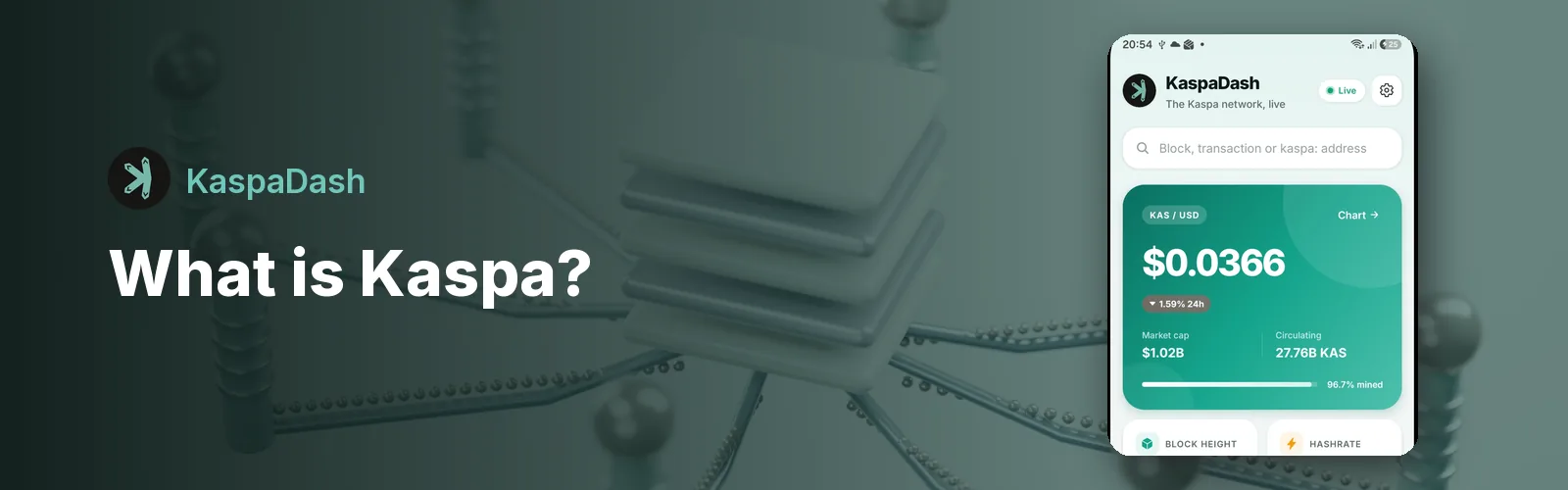
Kaspa (KAS) is a proof-of-work cryptocurrency built to be fast without giving up decentralisation. Where Bitcoin produces a block roughly every ten minutes, Kaspa produces ten blocks every second, and it still runs on miners securing the network the way Bitcoin does.
The BlockDAG
On a normal blockchain, if two miners find a block at the same time, one gets thrown away. At high speed that happens constantly, which is why most chains can't simply go faster. Kaspa uses a BlockDAG (directed acyclic graph): blocks can be created in parallel and each points to several earlier ones. The GHOSTDAG protocol then agrees on a single ordering of all of them, so nothing gets wasted.
Kaspa at a glance
- Consensus: proof of work (kHeavyHash algorithm)
- Speed: 10 blocks per second, with transactions typically confirmed within seconds
- Launch: November 2021, fair launch with no pre-mine or pre-sale
- Supply: hard cap of about 28.7 billion KAS. See Kaspa supply.
- Emission: block reward falls every month and halves yearly. See block reward reduction.
- Tokens: the KRC-20 standard lets projects launch tokens on Kaspa.
- Addresses: start with
kaspa:
Learn Kaspa by watching it
The easiest way to understand Kaspa is to watch it run. KaspaDash shows blocks landing live, the hashrate, the supply being mined and the reward countdown, and its built-in glossary explains terms like blue score and DAA score in plain English as you meet them.
KaspaDash: free Kaspa dashboard for Android
Live KAS price and charts, a real-time block explorer, a wallet watchlist, the whale tracker, supply and reward countdown, and every KRC-20 token. No account and no wallet connection needed.
Download Free on Google PlayIs Kaspa a good investment?
That's not something we can answer. Like all cryptoassets, KAS is volatile and high-risk, and you should never put in money you can't afford to lose. What we can do is make the network's public data easy to read, so whatever you decide is based on real numbers.